 CR2T
CR2T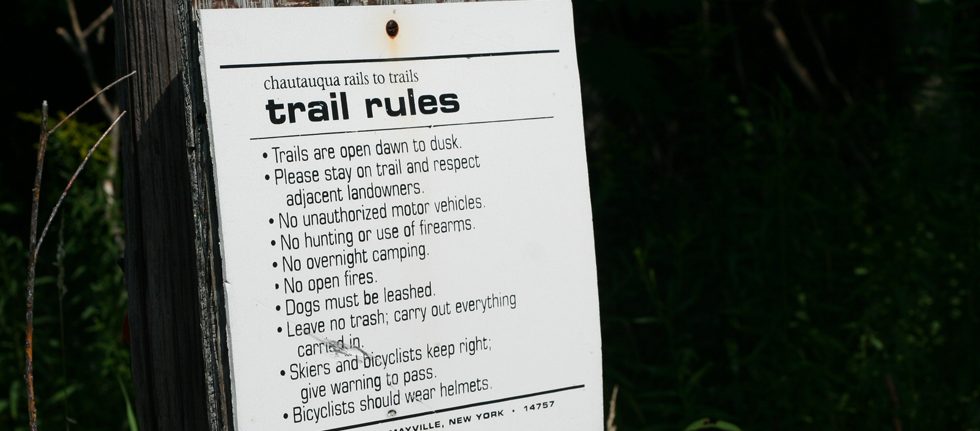
For safety and maintenance reasons CR2T must have a few rules
- Bicyclists should wear helmets
- Carry in – carry out. Leave no trash
- Pets welcome on leash only
- Please stay on trail and respect adjacent landowners’ rights
- No ATV’s – No motorcycles
- No hunting, camping or open fires on trails
- Slower trail users please keep right
- Faster trail users please give warning when passing
- Trails open dawn to dusk
CR2T policy on allowing persons with mobility disabilities to use power driven mobility devices on the rail-trail.
- On March 15, 2011 new Department of Justice rules will allow certain “power driven mobility devices” to be used on trails by “individuals with mobility disabilities”. Under the American with Disabilities Act, the DOJ says this rule is required.
- The definition of ‘other power driven mobility device’ is anything with a motor that can be driven, regardless of size or horsepower, if it is driven by a person who has mobility related disability.
- The new DOJ rules basically require Rails to Trails to allow the use of ‘other power-driven mobility devices’ by persons with mobility disabilities unless an assessment of the trail disallows such use based on very specific DOJ factors, further discussed in paragraph 5.
- Our policy is that a mobility disabled person using an ‘other power-driven mobility device’ is to be allowed to use that device on the trail. The person may not be asked if they have a disability or about their disability. However, we are allowed to ask the person to provide ‘credible assurance’ that the mobility device is required because of the person’s disability. Showing a disability parking placard will satisfy this requirement. However, a verbal representation of a persons’ disability, not contradicted by observable fact, shall also be accepted.
- CR2T has assessed its trail system and has concluded that passenger cars and pickup (or larger) trucks are not to be allowed as ‘an other power-driven mobility device’. The reason for this is that the size (dimensions) of cars and trucks are dangerous to drivers and other trail users on many of the fill areas of the trail. Many fills are so narrow on the top that a passenger vehicle would force other trail users over the edge if meeting such a vehicle, or that the vehicle could fall over the edge if the driver were not paying very close attention to his/her driving. Additionally, a passenger vehicle is capable of quite dangerous speed on the rail-trail.
- Consequently, the existing gates will continue to be kept locked to prevent cars and trucks from accessing the trails. The width of the gap between the gates will allow all other power driven mobility devices we presently envision to pass onto the trail.
CR2T policy on electric bikes (e-bikes)
- CR2T has developed a policy for the use of electric bikes (e-bikes) on the trails. Below is a general description and classification system used to describe the e-bike policy. This information was obtained from the Rail to Trails Conservancy, National Park Service, and People for Bikes. Class I e-bikes are allowed on all CR2T Trails, Class II e-bikes are allowed but encouraged for limited use, and Class III e-bikes are not allowed on any CR2T trails. Proper Trail Etiquette and Behavior rules still apply and need to be reinforced at all times.
- Classification of E-bikes
- The bike industry developed a three-tier classification system for e-bikes. This system is based on the power source and maximum assisted speed of the bicycle.
- Class I e-bikes are those in which the motor provides a boost only when a rider is pedaling. The boost cuts out at 20 mph, and the rider must rely on their own muscle power to go any faster. (Allowed)
- Class II e-bikes are those in which the throttle can be switched to provide a boost up to a maximum assisted speed of 20 mph, without any pedaling required. The boost cuts out at 20 mph, and the rider must rely on their own muscle power to go any faster. (Limited Use – allowed based on physical & medical limitations of the user, and could be either 2 or 3 wheel configurations)
- Class III e-bikes are pedal-assist like Class I’s, except they have a maximum assisted speed of 28 mph. They are also equipped with a speedometer. (Not Allowed)
- Typically, where e-bikes have been allowed off-road on multiuse trails, they have been Class I’s
and Class II’s, and are subject to the same rules and regulations that govern other cyclists. Maintain safe speeds. Heed all posted speed limits. Keep right, pass left and call out as you do. Yield to pedestrians, and other slower trail users.
 CR2T
CR2T 